
Fiji I Ula Tavatava Ex Norman Hurst
Fiji I Ula Tavatava Ex Norman Hurst
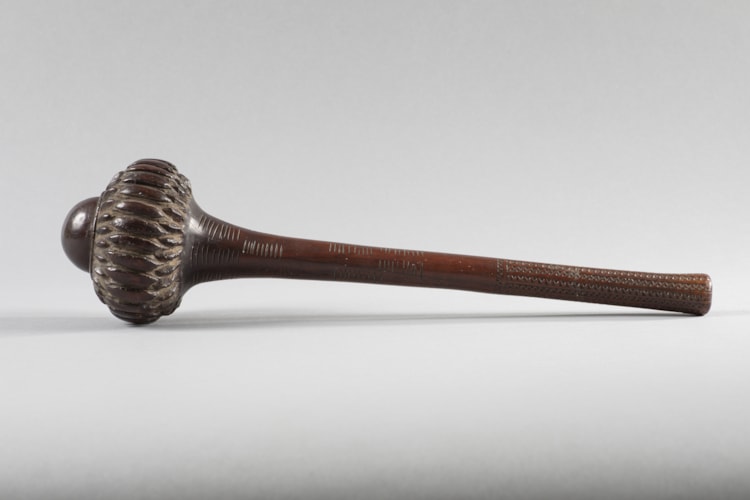
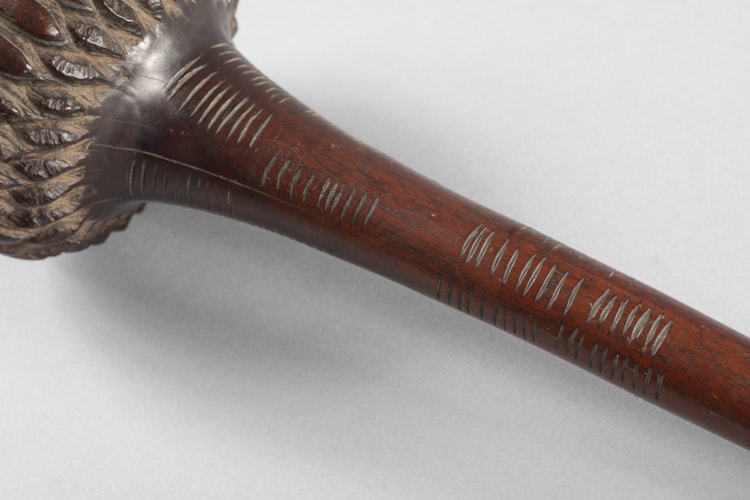
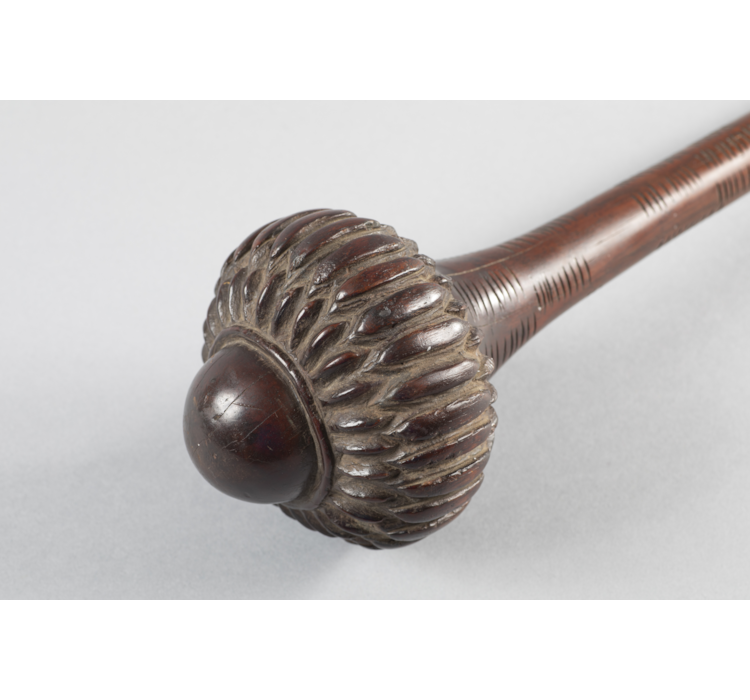
I ULA TAVATAVA, with 186 kill marks on the shaft. a very fine, functional, short throwing-club with a gadrooned or lobed (segmented) head and engraved grip.
Fiji, Polynesia
Ironwood (casuarina equisetifolia) with a superb patina of age and usage.
XVIIIth/XIXth century
46,5 cm.
A throwing-club, or I ULA TAVATAVA, with 186 kill marks on the shaft. The death tally is grouped in eighteen sections of 10 each and one of 6. The dome-tipped head is segmented into 28 large lobes edged with a ring of smaller studs to both sides. The grip is incised with fine geometric motifs thought to represent the stylized woven motifs of fiber mats, and the butt is recessed.
The superb quality of the club indicates that it was commissioned for a very important person, a chief or priest – and in any case, a warrior of great renown and skill. The short throwing-club, or ula, was the favored weapon of the Fijian warrior. Two or three clubs of different shapes were often worn thrust through his belt or sash. They were used not only as a bludgeon but most often they were hurled with great accuracy at the enemy from a distance of 10 to 20 meters. The intent was to knock down the opponent and then finish him off with a larger, two-handed war-club. The quantity of kill-marks is most unusual for a single weapon – possibly it is a grand total of the entire tally of the warrior up to the day the club was taken from him.
Provenance
Ex coll. : Norman Hurst, Cambridge, USA, N° NH-1127 04-0.
Norman Hurst was a renowned dealer of Tribal, Asian and Ancient art based in Cambridge Massachusetts. His personal preference was Polynesian art and moreover the superbly balanced and patinated “ethnographic” objects such as clubs, headrests, fishhooks, bowls etc. He had lovingly installed his marvelous and extensive Fijian collection in the WC of his apartement above the gallery on Mount Auburn Street. Visitors usually spent very long periods of time in this small intimate space enjoying the display of museum quality Fijian art works such as this club.
Literature:
According to Fergus Clunie (2003: 95), “[a] tally of the kills made with a club was often kept by means of nicks or notches on the head or handle, by boring small holes in the shaft, another common method being to inlay a tooth from each victim in the club's head.” Ref .: Clunie, Fergus. Fijian Weapons & Warfare. Suva: Fiji Museum, 2003.
Pub. : CASSE-TÊTE II : ARMES ET ARMEMENTS DE L'OCÉANIE. Exhibition catalogue, Gal. Meyer, Paris, 2022, pages pp. 150-153