
Copper Blade ULU
Copper Blade ULU
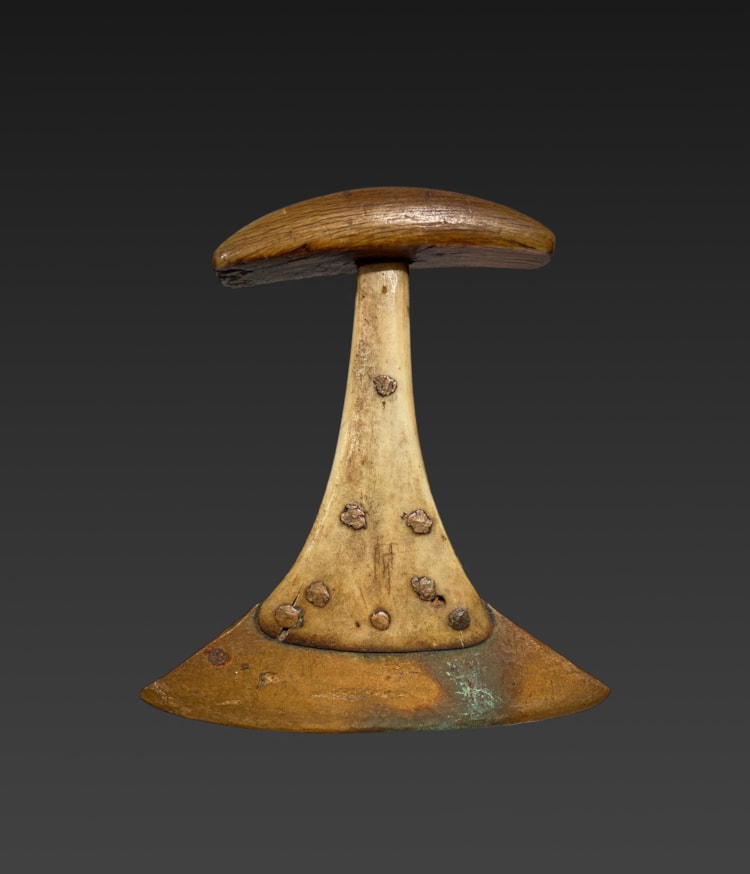
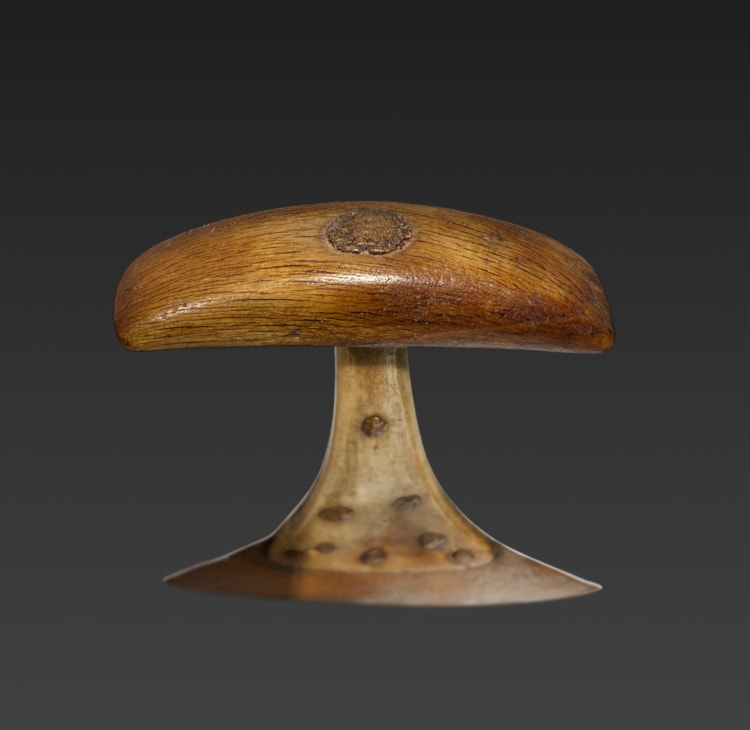
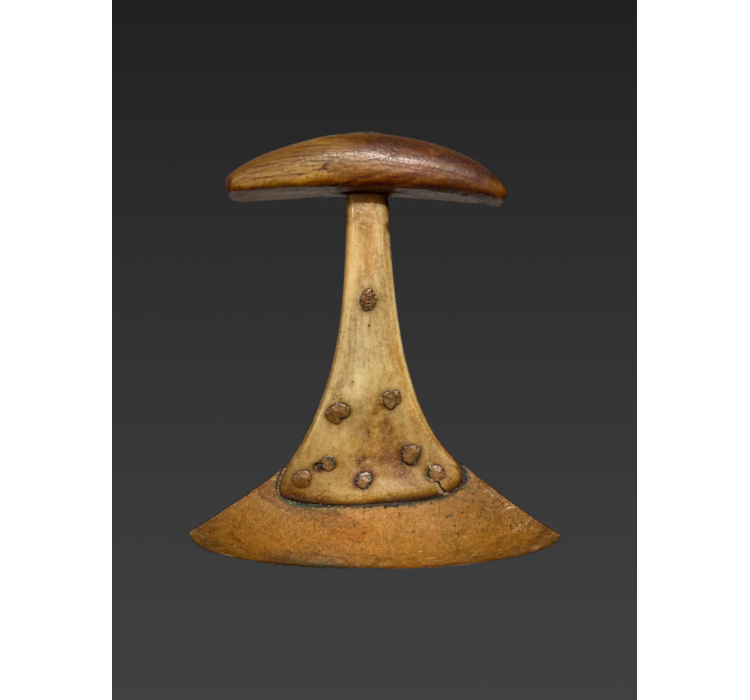
A very fine ULU, a functional female-use knife with a crescentic blade. Here the blade is made of a cold-hammered, native copper instead of the more usual slate or imported iron/steel examples. The tang of the blade is inserted into a triangular bone socket and held in place with eight copper rivets. The distal end of the bone socket is set into a centrally pierced, ergonomic handle.
Kugluktuk (Qurluqtuq : means « the place of moving water »), Copper Eskimo, Coppermine River Bassin, Nunavut, Central Northern Canada.
Native Copper, Caribou bone and Musk Ox or Mountain Sheep horn with a fine patina of age and use.
12,3 x 13,5 cm
19th century or earlier, Thulé culture.
Native-Copper in its natural state is often found on the surface or in running water where it is uncovered and reveled by nature. The pure, unadulterated copper nodules, crystalline structures or sheets can be hammered with stone or caribou antler mauls into desired shapes without heating – this is known as cold-hammering. The edge of copper blades made in this fashion retain a sharper and more durable edge than the stone ones. The Copper-Eskimo and other local populations used the hammered copper for utensils and ceremonial objects such as knives, spoons, rattles, and masks. The native copper from the Coppermine River was widely traded by the Eskimo and used as far west as the Tlingit and Haida tribes of coastal British Columbia, eastward to the Labrador Coast and southward as far as the Plains Indians of the Mid-West.
Provenance
Ex Adam Prout, London
Ex coll. Constantine Joicy, Athens
Literature:
See two examples in the British Museum : Am St.748 & Am1855,1126.326.
Ref. :
Cadzow, Donald A. : Native copper objects of the Copper Eskimo. Museum of the American Indian, Heye Foundation, New York, 1920
Eyman, Frances & Witthoft, John : Metallurgy of the Tlingit, Dene, and Eskimo in Expedition Magazine, Uni. Of Penn., Philadelphia, 1969
Wissler, Clark : The American Indian - an introduction to the anthropology of the New World
McMurtrie, New York, 1917