
FIJI Pendant Representing Two Vulva Ex Crane coll.
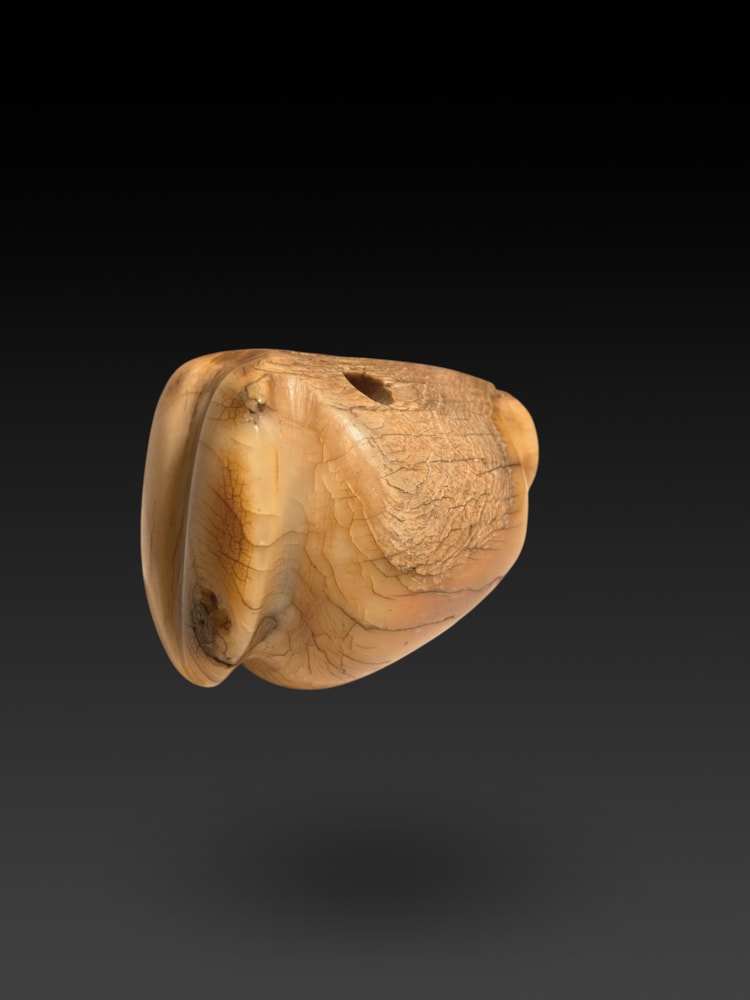
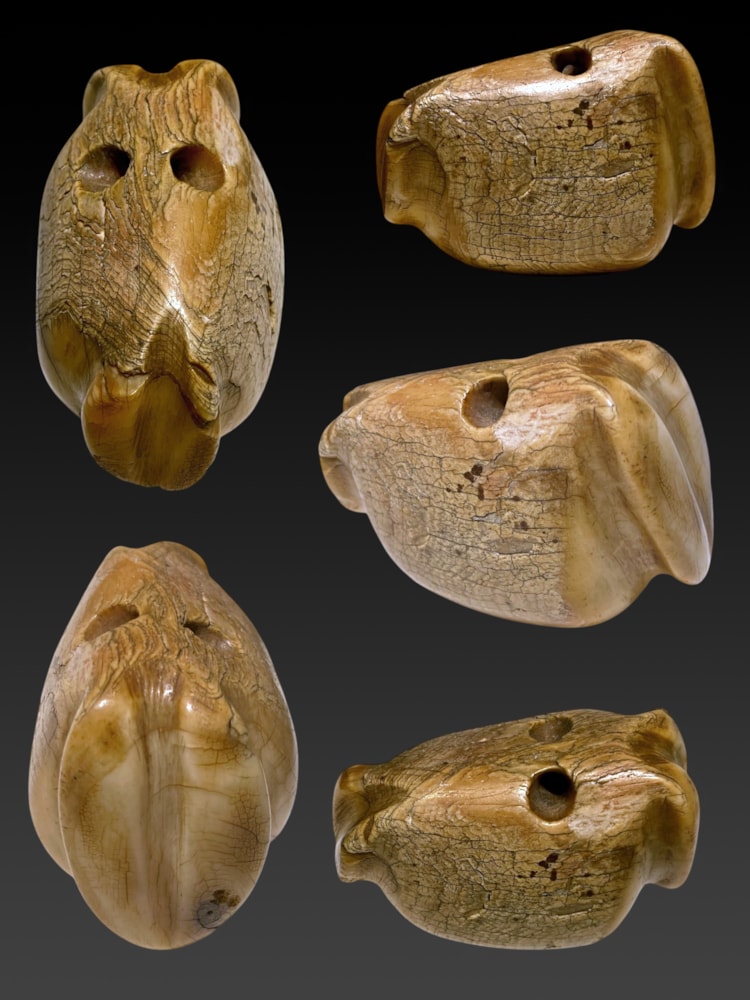
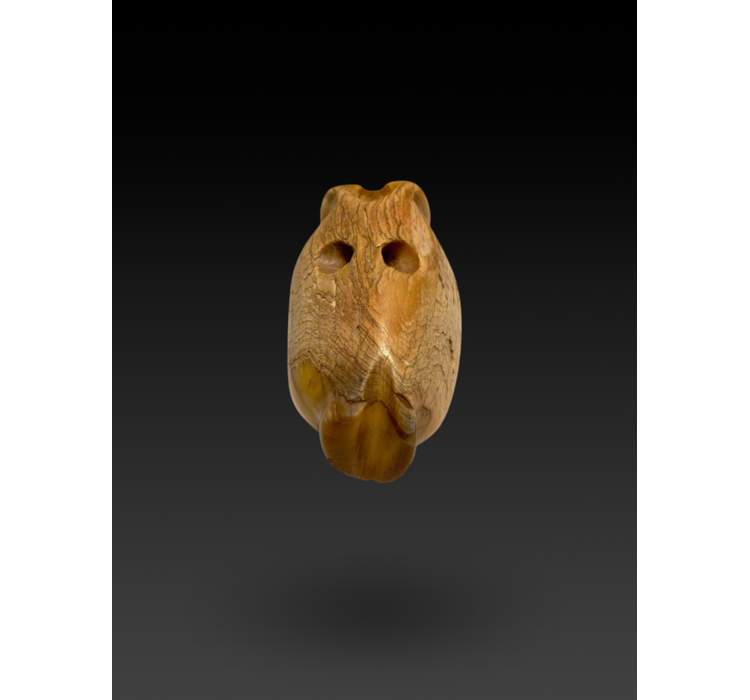
FIJI Pendant Representing Two Vulva Ex Crane coll.
An exceptional and rare form of ceremonial pendant representing two vaginas. The classical iconography of these pendants usually exhibits a nippled breast (or anus) on one side, with a vagina to the other. Here, the example is extremely unusual offering doubled female genitals. It is thought by Fergus Clunie that these pendants, for which the vernacular name is pule/buli, are perhaps the predecessors of the sacred presentation tabua or sacred sperm-whale tooth as the initial conical format of the whale-tooth is here preserved though shortened. All the known examples of these female pendants are of great age and appear to predate the contact period of the last third of the 18th century. The pendant is pierced through the top section with biconical holes for a suspension cord. The origin of this format is debated with a penchant towards a Royal Tongan origin subsequently appropriated by the Fijian royalty.
Tonga/Fiji, Polynesia.
Sperm-whale tooth (physeter catodon) with a very fine patina of great age and wear. 18th century or earlier.
Provenance
Provenance :
A private English collection. Acquired from Jean-Baptist Bacquart, Paris/London circa 2008.
Ex collection Arnold Herman Crane (1932-2014) : American lawyer, photographer and collector of photography, rings, and African Art, USA/France (acquired from Gal. Meyer in 2008).
Ex private collection by descent, USA/France.
Literature:
With regard to the meaning and/or function of this pendant it is of interest to note the basic similarity of form with that of the tabua, the ceremonial, and most sacred whale-tooth pendant, as well as the form of the revered golden or white cowries. Both the tabua and the cowrie are considered to be of female gender and while the whole tooth is of apparently phallic form, with the open end or root aperture of the tooth at its widest point which can easily be interpreted as the female genitals. The cowrie, either the golden (Lyncina aurantium) or the white egg-cowrie (Ovula ovum) in Fiji, with its crenelated or dentate lipped orifice is equated worldwide with female genitals and fertility. It is noted that Fijian women of high rank wore a cowrie shell ornament as a tight choker around their neck in relation to some form of fertility ritual, belief, or representation. Fijian chiefly houses were often decorated with large numbers of egg-cowrie attached in spaced rows on the outer walls.
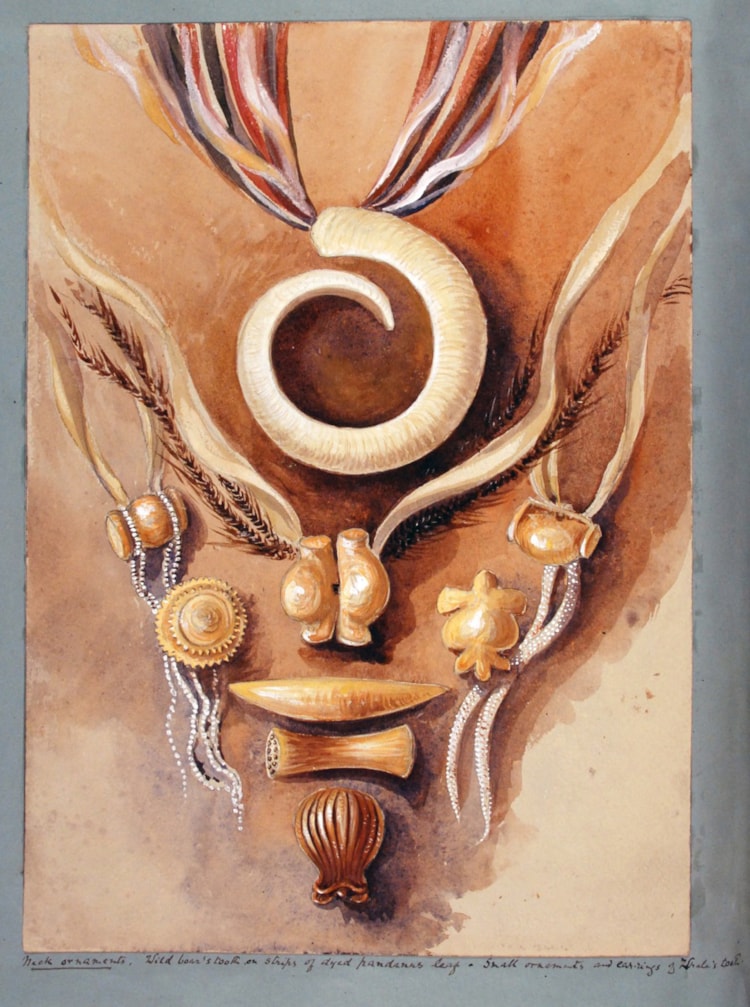
Although worn by chiefs of both sexes it is clear that the female genital pendants known as pule/buli (cowrie-shells) and the whale-tooth examples were female symbols related availability and possibly fertility. « According to Tongan traditional notions : The puleoto is a shell used for the necklaces of chiefs and is a valued ornament of chiefly virgins. To wear this shell is a mark of virginity, for if a girl who is not a virgin wears one suspended from her neck the shell will not lie properly upon her bosom but will turn over » (Collocott 1928: 139). In turning over, in other words, the telltale pule‘oto gave the lie by indecorously exposing the womans symbolic vagina. Physically, sexual symbolism is even more strongly expressed by the ivory counterparts of pule’oto and pulekula shells. While some of the few surviving whale-ivory specimens faithfully mimic the cowrie others are forme discrete or overt extrapolations in which the elongated, suggestively lipped mouth of the cowry is transformed into vulva that often envelops the root cavity of the whale-tooth. Some of these ivory pendants have a symbolic vagina at both ends, but the most common examples unmistakably represent a nippled breast backed onto a vagina. Taken together, the female character of the cowry shell and the ivory extrapolations, were used to embody goddesses and tapua gods notably Lehalevao.
For illustrations of ivory, breast-upon-vagina pule pendants, see Clunie 1986 : 68-69 ; Kaeppler 2010 : 213 ; Oldman 2004 : pls 59, 62. Centrally pierced tabuabuli include the British Museum’s BM 7057, collected by the Rev. J.S. Fordham ; the Museum of Archaeology and Anthropology’s MAA 1931-219, collected by A.P. Maudslay, and MAA 1918.213.74, collected by Sir Arthur Gordon.
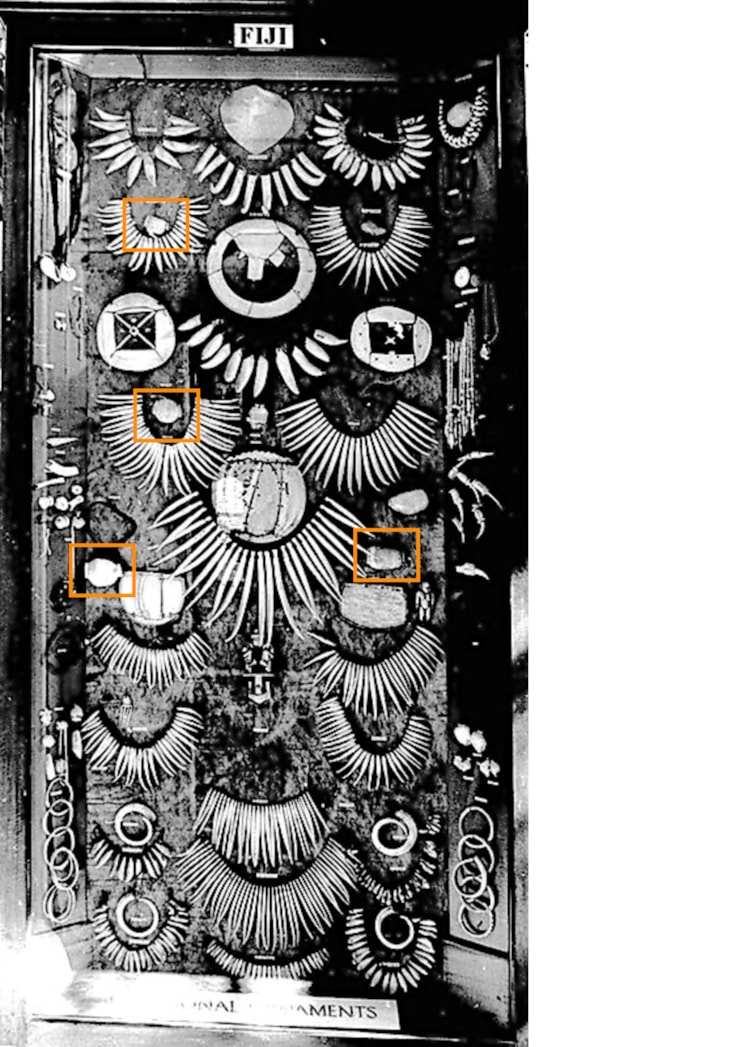
An identical example showing less age and wear is N° Z 2728; 1884.G41 in the Museum of Archaeology and Anthropology, Cambridge, described by Fergus Clunie as showing two vagina. Cambridge has at least 5 other examples of more classical format. There is a singular example of a genital shaped pendant of the classic format in the British Museum which is mis-described as “Cachalot pendant, a conventional imitation of the orange cowrie” (N° Oc1920,0322.15) and another whale tooth pendant carved in the stylized format of the cowrie (N° Oc1920,0322.13). Three others were previously in the collection of Robert Hales, London/Guernsey as well two in the stock of Jean-Baptiste Bacquarte, Paris (both acquired by Gal. Meyer in 2007/2008).
Ref. :
Clunie, Fergus: private communication
Clunie, Fergus : Yalo i Viti, Suva: Fiji Museum, 1986.
Clunie, Fergus : “The Tongan tapua”, in Herle, Anita & Lucie Carreau, eds. Cambridge Museum, 2013.
Clunie, Fergus : TAPUA “POLISHED IVORY SHRINES” OF TONGAN GODS. Sainsbury Research Unit, University of East Anglia, in Journal of the Polynesian Society : Vol. 122, No. 2, 2013.
Collocott, E.E.V. : TALES AND POEMS OF TONGA. Bernice P. Bishop Museum bulletin ; 46., Bernice P. Bishop Museum, Honolulu, Hawaii, 1928.
Ewins, Rod : Two important whaletooth ivory objects from Fiji, hidden under the sobriquet of “scrimshaw” in the W.L. Crowther Library Collection, Hobart. December 2013. www.justpacific.com.